


"Science doesn't inch forward. It ruptures."
Imagine an entire scientific community working under the same rules, asking the same questions, accepting the same answers — until something breaks. A new way of thinking emerges so fundamentally different from the old one that scientists trained in the original system can barely communicate with those who've adopted the new one.
That dramatic rupture is what Thomas Kuhn called a paradigm shift. It's one of the most important ideas in the philosophy of science — and one of the most misunderstood.
Before Kuhn, most people believed science advanced like climbing stairs: steadily, methodically, accumulating knowledge brick by brick. In 1962, Kuhn showed that picture was wrong. Science doesn't climb stairs. It trembles along stable ground for generations, then lurches into revolution.
This piece breaks down how that process works, why it matters, and what it means for the problems we're facing right now.
Part 1: What Is a Paradigm?
A Definition
Before we can talk about a paradigm shift, we need to be precise about what a paradigm is.
Kuhn defined it as a comprehensive model of understanding — a framework that gives a scientific field its rules, its priorities, and its methods. Think of it as a pair of glasses through which an entire community of scientists views the world. Those glasses determine:
- What to observe — which phenomena are worth studying, which are irrelevant
- What questions to ask — what problems deserve attention
- How to structure questions — what form research should take
- How to interpret results — what findings mean and why they matter
Why Paradigms Gain Power
Paradigms don't succeed because they're "true" in some absolute sense. They succeed because they work better than the alternatives at solving the problems scientists actually care about.
Newton's paradigm of physics wasn't accepted because Newton proved it was the final word on reality. It was accepted because it worked — it allowed accurate predictions, enabled engineering, and solved puzzles that no competing framework could touch. That practical track record is what makes a paradigm dominant.
This distinction matters enormously. Paradigms are tools, not revelations. And like all tools, they eventually meet problems they weren't designed for.
Part 2: The Kuhn Cycle — How Science Actually Progresses
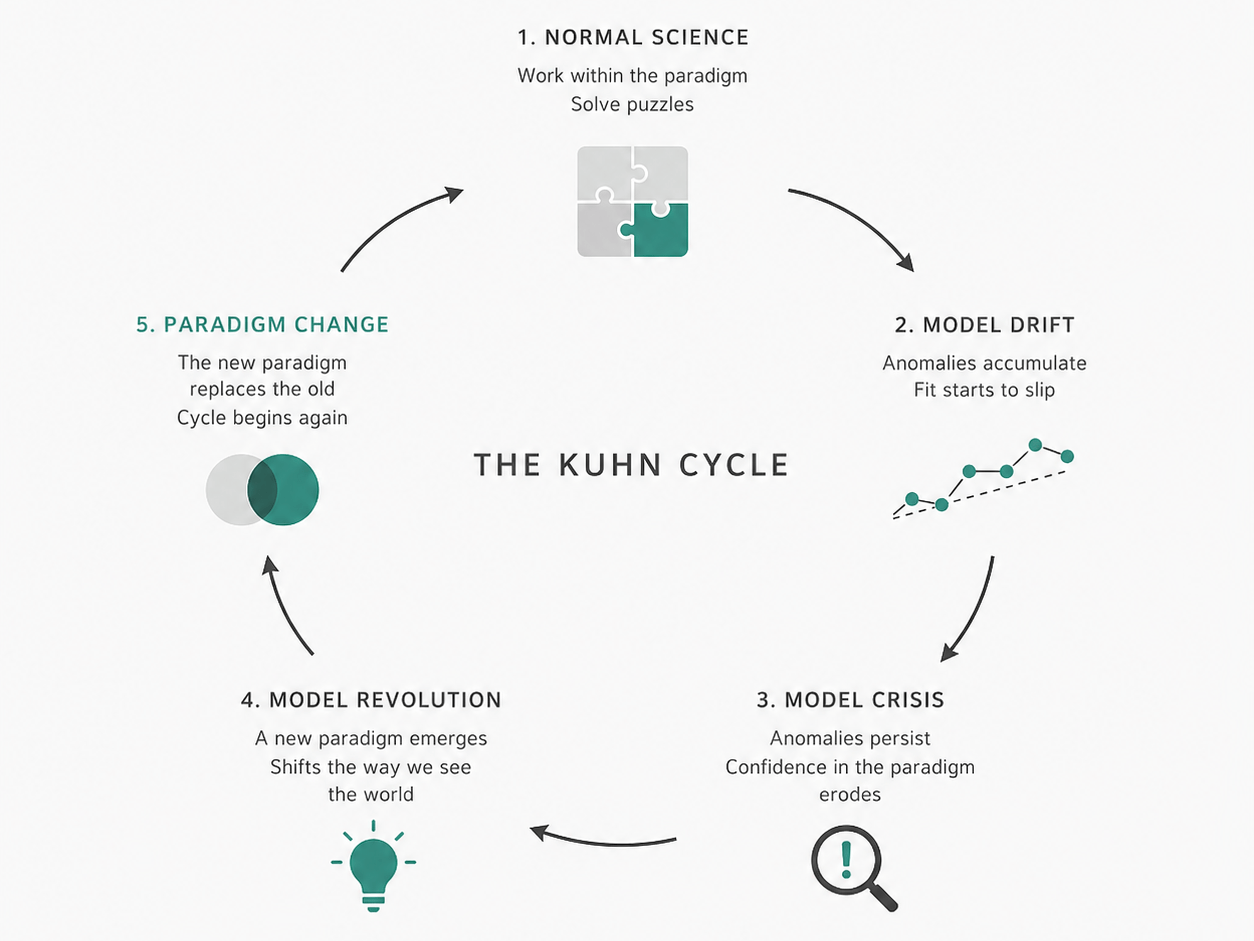
Kuhn's central discovery was that science doesn't progress smoothly. It moves through predictable stages, cycling through them repeatedly. Here's how each stage works.
Stage 1: Pre-Science
Every field begins somewhere. Before a successful model emerges, researchers are exploring without consensus — different groups using different methods, arriving at conflicting conclusions, with no shared framework to arbitrate between them. This is the wild frontier stage.
Fields stay stuck here until someone develops a working model that actually solves problems. Pre-Science isn't a failure state; it's a starting point. But it can last a very long time.
Stage 2: Normal Science
When a paradigm finally emerges and proves its worth, the field enters Normal Science — the longest and most productive stage in the cycle. Scientists working within the same paradigm share:
- A common framework
- Agreed-upon methods
- Shared goals and definitions
- Clear criteria for what counts as success
This shared foundation allows rapid, cumulative progress. Researchers can build on each other's work because they're all playing by the same rules. Newton's paradigm sustained nearly 300 years of Normal Science in physics — centuries of compounding discovery, all built on the same underlying framework.
"Normal Science feels permanent precisely because it's so productive. That's what makes its eventual collapse so disorienting."
Normal Science is also when the paradigm becomes invisible. It stops being a framework and starts being reality itself. Scientists don't think with the paradigm; they think through it. That's its greatest strength — and the source of its eventual fragility.
Stage 3: Model Drift
As scientists push deeper into complex phenomena, they start encountering anomalies — observations that the paradigm can't adequately explain. These aren't minor inconsistencies that better data will resolve. They're genuine violations of what the model predicted.
At first, researchers assume these are solvable within the existing framework. Add more data. Refine the model. Patch the edges. The paradigm shows signs of wear, but it still functions. The field continues, increasingly reliant on workarounds it hasn't quite acknowledged as workarounds.
This happens to every paradigm. No model can explain everything forever. As knowledge grows, edge cases accumulate that the original framework simply wasn't designed to handle.
Stage 4: Model Crisis
If anomalies keep accumulating and no patches hold, the field enters Model Crisis. This is where the old paradigm stops working:
- It can no longer solve the core problems it was built to solve
- Predictions become unreliable
- Decision-making drifts toward guesswork
- The consensus that once held the field together begins to fracture
This phase is deeply uncomfortable in ways that go beyond the intellectual. Scientists have built entire careers on the old paradigm. They've internalised its logic, structured their thinking around it, built their reputations within it. A paradigm crisis doesn't just challenge their ideas — it challenges their identity.
They know the rulebook is broken. They don't yet know what should replace it. That gap — between the failure of the old and the absence of the new — is the most disorienting place a scientific community can find itself.
Stage 5: Model Revolution
From the struggle to solve the crisis, new candidate paradigms emerge. Unlike Normal Science, this stage is genuinely revolutionary. The new paradigm isn't a refined version of the old one — it's radically, structurally different.
What Makes a Revolution
A true paradigm revolution has specific characteristics:
- The new model solves problems the old paradigm couldn't
- It reframes the field's central questions entirely
- It's often incommensurate with the old paradigm — meaning the two models operate on such different logic that they can't be directly compared using neutral criteria
Incommensurability is the concept that trips most people up. Imagine two people in a debate, each operating under a completely different set of rules. Person A says: "Your argument violates rule X." Person B responds: "Rule X doesn't exist in my framework." They're not just disagreeing. They're not even playing the same game.
That's what happens between paradigms. Scientists trained in the old framework don't resist the new one because they're stubborn. They resist it because their entire intellectual formation makes the new paradigm seem alien — or simply wrong.
Why Change Happens Slowly
Paradigm adoption typically follows generational lines. Scientists who built their careers on the old paradigm rarely fully convert; those who trained after the shift have no such investment. As Max Planck observed — with some bitterness — science advances one funeral at a time.
Stage 6: Paradigm Change
Eventually, the new paradigm gains enough influential support to shift the field's centre of gravity. The community transitions. The new paradigm is refined and applied. Scientists retrain and reorient. The old framework fades — not disproven so much as abandoned, left behind by a field that found something that worked better.
Normal Science resumes. The cycle begins again.
Part 3: The Deeper Dynamics
The Paradigm as Invisible Glasses
The most profound insight in Kuhn's work isn't about scientific method. It's about perception.
Scientists working under different paradigms don't just disagree on answers. They literally don't see the same phenomena. They observe different things, ask different questions, interpret the same data differently. The paradigm shapes what counts as evidence, what counts as a problem, and what counts as a solution.
This isn't irrationality. It's how deeply paradigms embed themselves. They don't sit on top of knowledge — they structure the apparatus through which knowledge is gathered.
Why Crisis Is Inevitable
Three pressures build during any period of Normal Science:
Completeness pressure. As understanding grows, researchers encounter cases the paradigm was never designed to handle.
Depth pressure. Digging deeper into phenomena reveals edge cases and exceptions the surface model didn't predict.
Extension pressure. Applying the paradigm to new domains exposes its limitations in unfamiliar territory.
These pressures don't announce themselves. They accumulate. And eventually they exceed what any set of patches can accommodate.
Why Resistance Is Rational
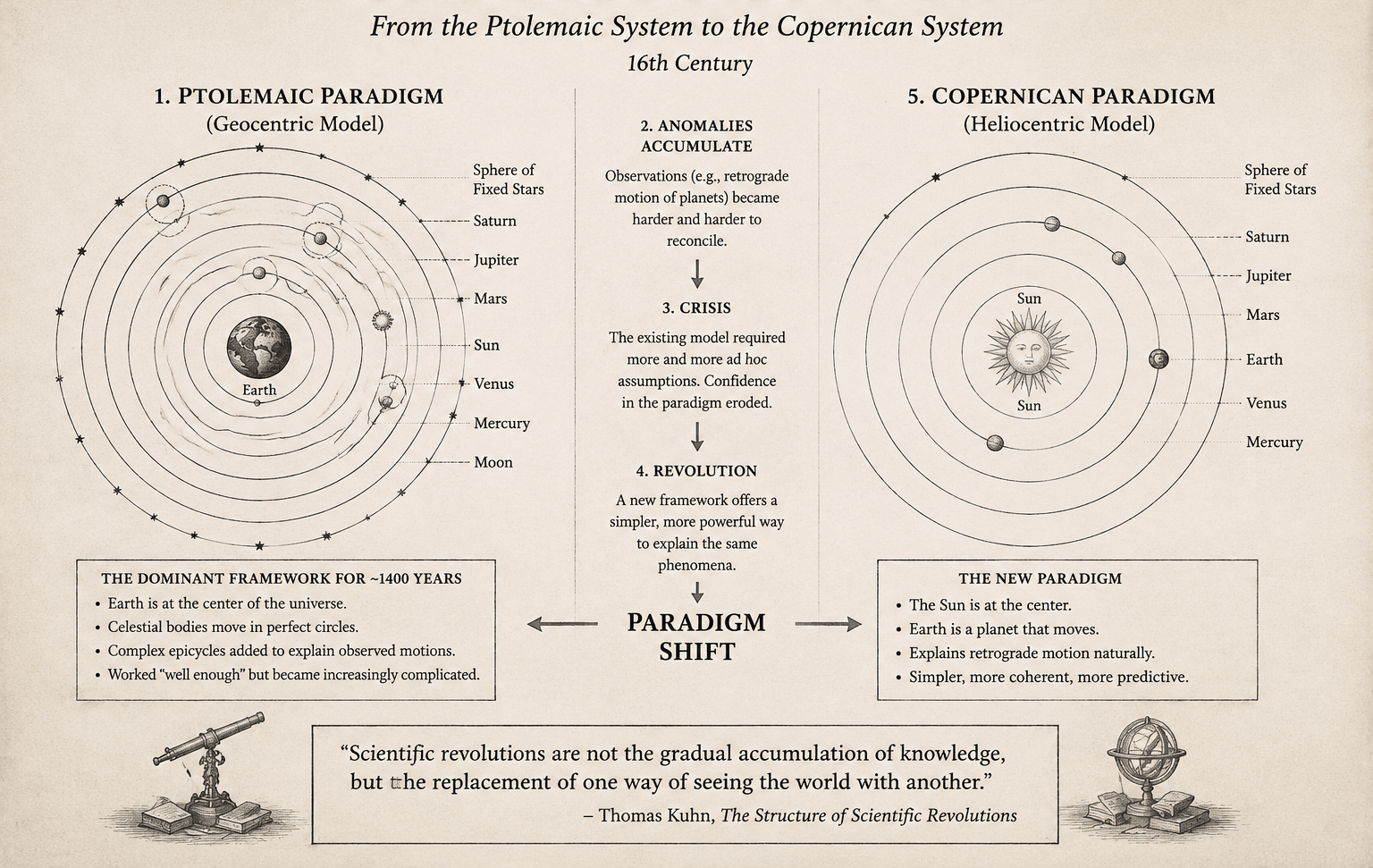
It's tempting to look back at scientists who resisted paradigm shifts — those who clung to Ptolemaic astronomy, or dismissed germ theory, or rejected relativity — and see simple stubbornness. Kuhn's argument is that this reading is unfair.
Resistance to paradigm change is rational given the circumstances:
- Scientists have invested careers in the old framework
- Their professional identity is built around it
- The new paradigm is unproven and often poorly articulated at first
- Old and new paradigm believers genuinely can't communicate clearly with each other
What looks like irrationality from the outside is, from the inside, a reasonable defense of a framework that has earned its authority.
Part 4: A Parallel in Nature
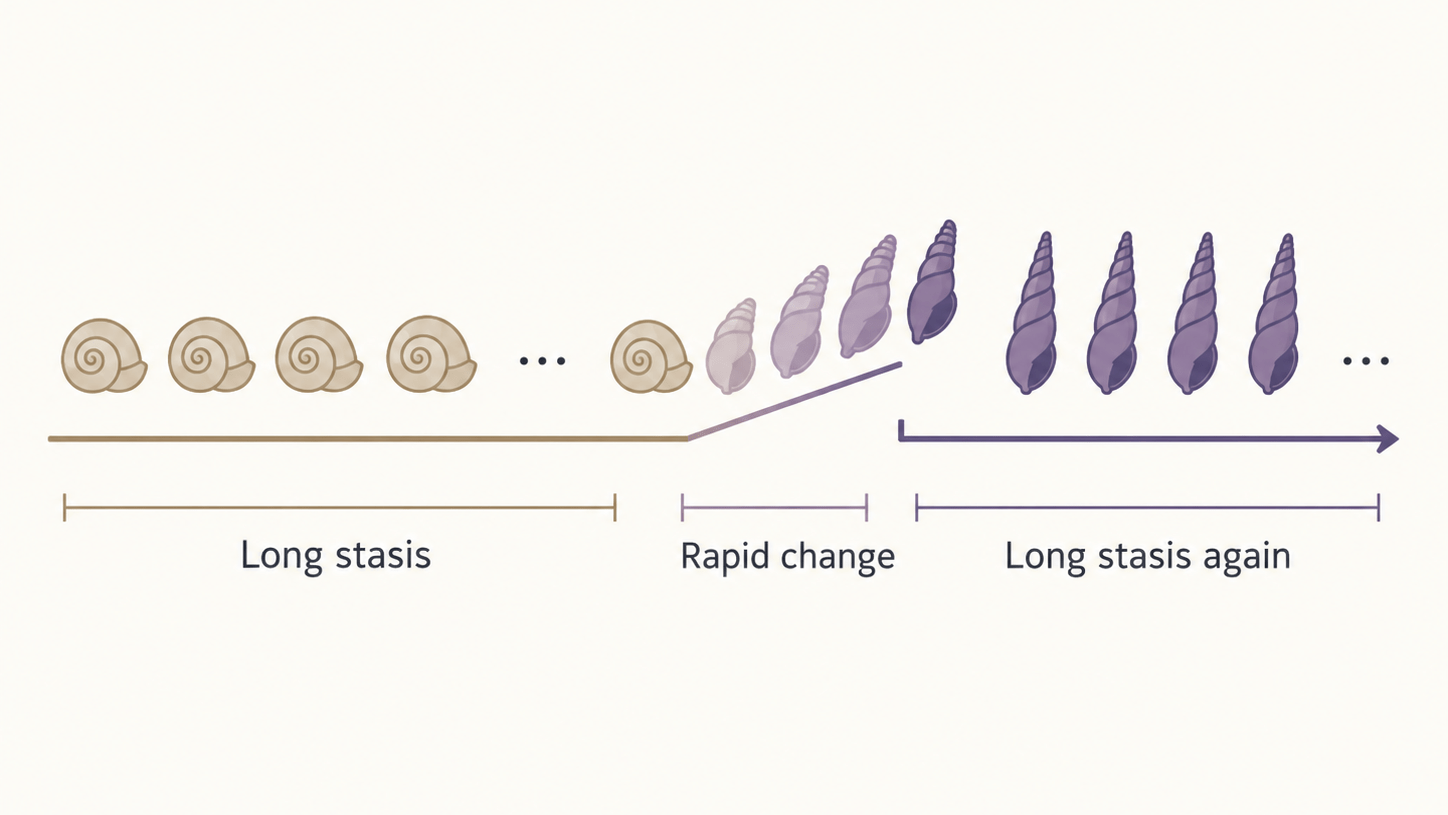
Kuhn's cycle has a direct parallel in evolutionary biology. The theory of punctuated equilibrium describes how most species remain relatively stable for long geological periods — then change rapidly during brief speciation events. Long stasis. Sudden rupture. Long stasis again.
The pattern is identical to the Kuhn Cycle: extended periods of stability punctuated by brief, revolutionary change. This parallel isn't just an interesting observation. It suggests that Kuhn's framework may describe something deeper than scientific sociology — a fundamental pattern in how complex systems of any kind respond to accumulated pressure.
Part 5: Why This Matters Now
The Sustainability Crisis as Model Crisis
Kuhn's framework isn't just useful for understanding the history of physics. It's essential for understanding where humanity stands right now.
The global environmental sustainability problem is so large and so structurally novel that solving it within the existing paradigm isn't possible. The dominant framework that shaped the industrial era rested on a set of foundational assumptions:
- Economic growth can be infinite
- Natural systems can be exploited without systemic consequence
- Progress means continuous expansion
That paradigm worked — spectacularly, for a period. It built the modern world. But it can't solve the sustainability crisis, because the sustainability crisis is, in Kuhn's terms, the accumulation of anomalies that the old paradigm can no longer explain away.
We're in Model Crisis. The old framework is failing. We don't yet have a replacement that the field has converged on.
Why Environmentalism Hasn't Solved It
Environmentalism emerged in the 1960s — notably, with Rachel Carson's Silent Spring published in 1962, the same year as Kuhn's Structure of Scientific Revolutions — to address the gap the old paradigm left open. But environmentalism itself remains in Pre-Science. It hasn't yet produced a unified, proven paradigm for solving sustainability at civilisational scale.
This is the real problem. Civilisation is in Model Crisis, needing a new paradigm. But the field that should be generating that paradigm — environmentalism, sustainability science, ecological economics — hasn't yet resolved its own foundational debates.
The Primary Problem
"We won't solve the sustainability crisis by trying harder within the existing framework. We need a new framework — one that makes the solutions obvious in the way Newton's physics made engineering obvious."
This reframes what the actual challenge is. The primary problem isn't finding better sustainability solutions within the existing paradigm. It's finding the new paradigm that will make solutions possible.
Without a fundamentally different way of thinking about:
- How economic systems relate to natural limits
- What "progress" and "success" actually mean
- How growth works within planetary boundaries
- What humanity's relationship to natural systems should look like
...incremental improvements will keep falling short. The effort isn't the problem. The framework is.
Part 6: The Framework at a Glance
The Six Stages
| Stage | What's Happening |
|---|---|
| Pre-Science | No consensus, competing approaches, no dominant model |
| Normal Science | A paradigm works; rapid, cumulative progress within it |
| Model Drift | Anomalies appear; patches are applied; cracks widen |
| Model Crisis | The paradigm fails; confidence collapses; no replacement yet |
| Model Revolution | New candidate paradigms emerge; field is contested |
| Paradigm Change | New paradigm wins; Normal Science resumes under new framework |
Key Relationships
Paradigms enable progress by providing shared frameworks — but eventually limit it by becoming too rigid to accommodate new discoveries. Anomalies accumulate slowly, but their effect is cumulative: one or two problems can be explained away, but enough force crisis. Crisis creates the conditions for revolutionary thinking, but also generates paralysis and resistance. New paradigms are resisted by those invested in the old, then gradually adopted by those who aren't. And each new period of Normal Science eventually generates its own anomalies — the cycle doesn't end.
What This Changes
Understanding the Kuhn Cycle shifts how you read the landscape of any field:
- You can recognise which stage a field is actually in
- You can understand why paradigm shifts feel threatening rather than liberating to those inside them
- You can stop mistaking long stability for permanent truth
- You can recognise that crisis — painful as it is — is often the necessary precondition for revolutionary progress
- You can see that major problems usually require rethinking foundational assumptions, not just working harder within existing ones
Conclusion
Thomas Kuhn's framework reveals that human knowledge doesn't advance through steady accumulation. It advances through revolution — long periods of stable, productive Normal Science, punctuated by crisis, followed by the emergence of fundamentally new ways of thinking.
That's not a pessimistic picture. It's an honest one — and in some ways a hopeful one.
When you recognise that a field is in crisis, Kuhn's framework tells you what that means: not that the enterprise has failed, but that it has reached the limit of its current paradigm. The solution isn't more effort within the broken framework. It's a new framework. That's not failure. That's the beginning of revolution.
The challenges we're facing — climate, sustainability, the reshaping of social and economic systems — are not problems that will yield to incremental improvement. They require paradigm shifts as fundamental as the ones Kuhn documented in the history of physics. Understanding that is the first step toward making them possible.
Further Reading
- The Structure of Scientific Revolutions — Thomas S. Kuhn (1962)
- Silent Spring — Rachel Carson (1962)
- The Logic of Scientific Discovery — Karl Popper
- Punctuated Equilibria — Niles Eldredge and Stephen Jay Gould
No Comments.